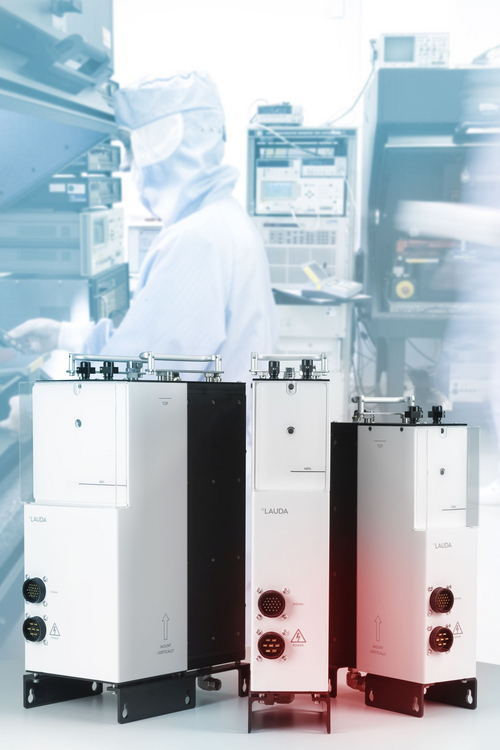
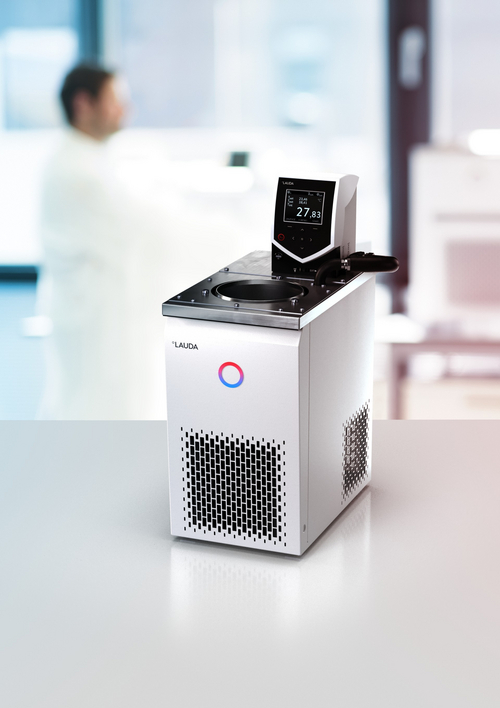
LAUDA has renewed its portfolio of thermoelectric process thermostats. The LAUDA Semistat product line boasts both energy efficiency and the smallest footprint in the industry. Semistat thermostats are used in the semiconductor industry.
LAUDA Introduces New Thermoelectric Process Thermostats
Thermoelectric process thermostats, which are used in the temperature control of etching processes in the semiconductor industry, have been a permanent feature of LAUDA’s comprehensive portfolio since its acquisition by Noah Precision (now LAUDA-Noah) in 2014. Now the global market leader has fully revised and expanded the former POU product line with the new “Semistat” series.
The new LAUDA Semistat product line comprises three models: LAUDA's Semistat S 1200 is an affordable entry-level device that offers an even smaller footprint than its predecessor – with the same cooling output of 1.2 kW at 20°C. Meanwhile, the newly developed Semistat S 2400 retains the mechanical and hydraulic structure of the product line. The process thermostat also incorporates the latest innovations from the thermoelectrics sector, such as the latest generation of high-performance Peltier elements, which guarantees a higher power density and greater reliability. With the Semistat 4400, LAUDA has brought a whole new performance class with 4.4 kW cooling output to market. This process thermostat is specially designed for applications using 300 mm wafers with a high cooling output requirement at low temperatures.
Thermoelectric process thermostats for the semiconductor industry from -20 to 90 °C
Semistat process thermostats have been optimized for precision temperature control in plasma etching applications in the semiconductor industry. Defined areas are removed from the surface of the wafers during the etching process. A dynamic temperature controller keeps the wafer chucks located inside the plasma etching chamber at a constant temperature, to prevent temperature drift. The constant temperature is crucial in maintaining a stable etching profile and producing a high-quality surface. Peltier technology realizes the two main advantages of Semistat thermostats: energy and space savings combined with maximum long-term operational stability.
The new process thermostats are extremely energy-efficient because they only control the temperature and consume energy when there is a need to regulate the temperature inside the etching chamber. Since the Peltier element is the only component used for heating and cooling, it is possible to minimize the space requirements of the thermostat. The compact design and optional underfloor installation ensure that minimal space is occupied in the cost-intensive cleanroom. A small internal fluid volume and short hose connections from the device to the application mean that less energy is required to control the fluid temperature. The low volume of the temperature control fluid, in particular, allows rapid temperature changes. Semistat temperature control systems use up to 90 percent less energy than compressor-based systems.
Like its established predecessor, the Semitat product line has a working temperature range of -20 to 90°C and offers a high temperature stability of ±0.1 K. With cooling outputs from 1.2 to 4.4 kW, the water-cooled devices can be used in combination with a large variety of chamber and platform models.
The most important functions of LAUDA Semistat process thermostats
- Compressor and refrigerant-free system with low energy consumption
- Smallest footprint in the industry
- Extremely low volume of heat transfer fluid
- Use of perfluorinated fluids
- Improved accessibility and minimal cleanroom use
- No filters or DI components required
- High reliability and low operating costs
- Locally exchangeable modules for easy troubleshooting
- Dynamic, stable temperature control at the point of use
- Temperature drift prevention for stable etching profiles
- Improved wafer-to-wafer stability
Measures for the maintenance of business operations
The global situation regarding the coronavirus has changed dramatically and has reached unexpected proportions. Today, we have once again defined important measures within the company that also have an impact on our business operations. We have drawn up a plan that will keep our business operations going for as long as possible. However, there may be certain restrictions on accessibility.
We have decided that from 17 March 2020, all business trips from Germany to other countries will be prohibited. In addition, we will not receive any business visits from abroad from 17 March until further notice. We ask for your understanding. It is important to us to emphasize that the health of our employees is always our top priority.
Furthermore, we try to conduct our business in such a way that our customers are affected as little as possible. However, certain effects cannot be avoided due to the epidemic. We thank you for your understanding and are available to answer your questions.
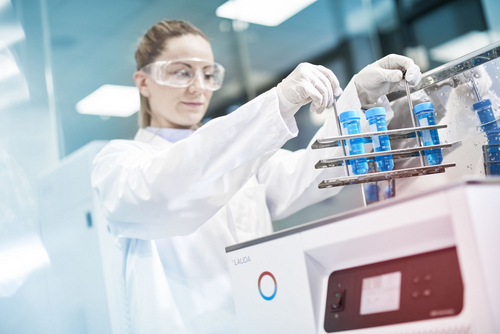
All Hydro device types are protected against overheating during dry running by means of a low-water safety device and optional water level control, thereby guaranteeing reliable continuous operation. (Source: LAUDA)
New LAUDA Hydro water and shaking water baths up to 100 °C – high quality, intuitive, reliable
2020 – LAUDA, the world market leader for constant temperature equipment and systems for precise temperature generation, has extended its laboratory technology product range. The launch of the new LAUDA Hydro waterbath product line, reinforced by the addition of "GFL Technology", means that LAUDA can now offer a considerably extended range of products. In this respect, LAUDA is continuing the tradition of the GFL brand, which has been valued in laboratories for its durability and superior quality for over 50 years. The GFL company has been part of the LAUDA Group since the beginning of 2019 and will be further expanded as a development and production location.
LAUDA Hydro water baths: Equipped for every laboratory application
Water baths are an indispensable part of many process chains in laboratories. The Hydro product range offers the perfect equipment for every laboratory requirement with six water baths, two water baths with a circulating function and three shaking water baths. The LAUDA Hydro water baths with an interior made of high-quality stainless steel provide the right bath depth and openings for every application with bath volumes from 4 to 41 liters. They are designed for the needs of biological, medical or biochemical laboratories with excellent temperature homogeneity, optional circulation or a shaking function.
Homogeneous temperature distribution
The heater of the LAUDA Hydro water baths is located directly under the bottom of the screen. This ensures homogeneous temperature distribution and rapid achievement of the desired temperature with a high temperature stability of ±0.1 K. The heater power is adjusted to the size of the bath. The optional circulating function is ideal for applications which require both temporal and spatial temperature distribution throughout the bath. Water baths with a circulating system have an excellent temperature homogeneity of ±0.02 K.
All water baths offer a temperature range of up to 100°C, which also permits applications in the boiling temperature range. A timer function can be used to set a switch-on delay and the duration of the operating time, either after a switch-on delay or after reaching the set temperature. The high-contrast 3.5-inch TFT display shows all the settings and operating values. The controller also has an electronic function check with a visual and acoustic alarm signal in the event of an error. The double overtemperature protection allows reliable continuous operation, even in the absence of the operator.
LAUDA Hydro water and shaking water baths from 10 to 100 °C – high quality, intuitive, reliable
The shaking water baths of the LAUDA Hydro series can be used for a variety of tasks in the laboratory depending on requirements. The device type H 20 SOW creates a circular motion for the sample whereas the types H 20 S and H 20 SW are designed for a linear, oscillating shaking movement. This is because variable mixing of the samples is required depending on the application. For example, applications in biotechnology are often dependent on an orbital shaking movement.
The built-in speed controller enables a load-independent, infinitely variable shaking movement with a soft start. The two shaking water baths H 20 SW and H 20 SOW are equipped with a cooling coil as standard. The temperature range of the shaking water baths can be extended down to 10 °C by connecting them to the domestic water supply or to commercially available circulation chillers.
LAUDA Hydro: User safety and a long service life
All Hydro device types are protected against overheating during dry running by means of low-level protection. The Hydro shaking water baths have water level control as standard, which guarantees reliable continuous operation. Furthermore, they consist of a corrosion-resistant outer casing made of electrolytically galvanized, powder-coated sheet steel. The interior parts of the casing and the tubular heating element are made of stainless steel. The double-walled, heat-insulated cover with internal curvature reliably prevents condensate from dripping back into the system. The recessed operating elements protect the electronics from dripping water and dirt. This increases the service life and ensures a high level of user safety.
LAUDA has rounded off its new water bath line with vaporization baths and a tissue float bath for special applications such as gentle evaporation from Erlenmeyer flasks and the stretching and drying of sectioned tissue samples. The new LAUDA Hydro water baths are available as of now and will replace the previous line of LAUDA Aqualine water baths by the end of March 2020.
- Picture: LAUDA Hydro water bath (169 KB)
- Picture: LAUDA Hydro shaking wather baths (145 KB)
- Product picture: LAUDA Hydro water bath (187 KB)
- Product picture: LAUDA Hydro shaking water bath (133 KB)
- Pressemitteilung LAUDA Hydro Wasserbad (43 KB)
- Press Release: LAUDA Hydro water baths (38 KB)
- Comunicado de prensa: LAUDA Hydro baños de agua (39 KB)
- Communiqué de presse: LAUDA Hydro bains-marie (39 KB)
- Пресс-релиз: LAUDA Hydro Водяная баня (40 KB)
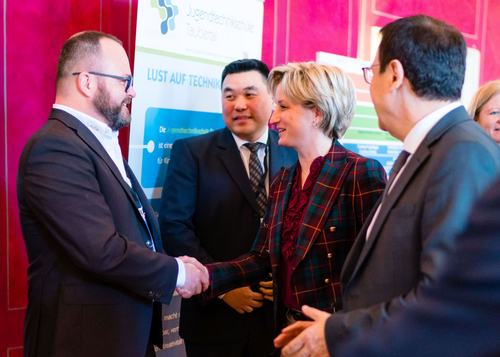
The CEO and President of LAUDA, Dr. Gunther Wobser (l.), welcomes the Minister of Economic Affairs of the State of Baden-Württemberg, Dr. Nicole Hoffmeister-Kraut, together with Campus Director Prof. Dr. Kim (2nd from left) and the Chairman of the CDU faction in the State Parliament, Prof. Dr. Wolfgang Reinhart (r.) (Source: Ludmilla Par-syak Photography / Fraunhofer IAO)
LAUDA sets impulses at the Popup Labors Baden-Württemberg
With a "Everyday view of digitisation at LAUDA", the President and CEO of LAUDA, Dr. Gunther Wobser, opened the series of lectures at the action day "Digitisation and sustainability for BW and worldwide" with a keynote speech on 10 February. The action day is part of the 6th "Po-pup Laboratory BW", a digitisation project of the state of Baden-Württemberg. The aim of the Po-pup Lab BW is to give small and medium-sized companies in the state an understanding of innovative technologies or business models and to provide concrete recommendations for action on the basis of workshops or best practice examples.
Components of the digital strategy of the world market leader
In his presentation to representatives from politics and business, Dr. Wobser pointed out the great importance of digitization in the industry. The exponentially increasing technical development, e.g. Moore's Law of Computer Performance, stands in contrast to the linear human adaptability. As a result, new companies with disruptive forces are increasingly pushing into the market. LAUDA meets this challenge, among other things, through strategic cooperation with start-ups such as ENER-IQ, Coolar and watttron, according to Dr. Wobser. LAUDA's own LAUDA innovation laboratory in Silicon Valley and the Digital Agenda, which is aligned with the corporate strategy, are further components of LAUDA's digital strategy.
Appeal to politicians
At the end of his keynote speech, Dr. Wobser addressed the political community with forceful words: The Main-Tauber-Kreis is in the final group of districts in terms of innovative ability, ranking 39th out of 44, and the trend is downward. Further active support is required, for example in the expansion of the Baden-Württemberg Cooperative State University Mosbach with the Bad Mergentheim campus as "anchor point of digitalisation". Dr. Wobser criticized that too often, medium-sized companies have to carry out complex digitization projects with their own resources without the support of the state and immediately reduce the results as an investment.
At the LAUDA stand, the Minister of Economic Affairs of the State of Baden-Württemberg, Dr. Nicole Hoffmeister-Kraut, accompanied by Campus Director Prof. Dr. Kim and the Chairman of the CDU faction in the State Parliament, Prof. Dr. Wolfgang Reinhart, were able to gain an impression of two digital projects of LAUDA. The family business thus demonstrated a practical application of virtual reality with the LAUDA showroom. LAUDA also demonstrated the connection of the industrial recirculating chillers to its own LAUDA Cloud including data visualisation via a tablet. This enables users to check the device status at any time, regardless of location, and also to change parameters directly.
The LAUDA ECO REJ 1225 G calibration thermostat is ideal for the calibration of glass thermometers or electric thermometers. (Source: LAUDA)
New ECO calibration thermostat fulfills the exacting re-quirements of test laboratories
With the LAUDA ECO REJ 1225 G calibration thermostat, LAUDA has released a piece of constant temperature equipment designed for the specific requirements of test laboratories and customers who perform calibration and adjustment work on a daily basis. The equipment has been specially developed for the precise calibration of thermometers, such as industrial platinum resistance thermometers, temperature probes, thermocouples or electric thermometers. Liquid calibration baths are considered the most stable temperature source and offer the most consistency for the comparative calibration of temperature probes and sensors in a laboratory. They use a large quantity of liquid to maintain a stable and homogeneous test environment for the calibration of calibration objects of varying sizes, shapes and lengths.
These applications call for calibration thermostats that maintain a constant, temperature-independent liquid level. To achieve this, LAUDA uses a two-chamber bath, consisting of the temperature chamber and the application chamber, also known as the overflow vessel, usable space or buffer chamber. A pump unit pumps the medium from the temperature chamber to the application chamber, which has an overflow at a certain level. From here, the bath medium flows back into the temperature chamber. The ECO calibration thermostat also has a height-adjustable, cylindrical working chamber. This makes it possible to adjust the liquid bath surface in the working area to above cover plate height. Fully immersed thermometers can thus be read directly at the immersion point. In addition, the separate working chamber provides a constant immersion depth regardless of the volume expansion of the bath liquid, an excellent temperature stability of ±0.02 K and a homogeneous temperature distribution within a working temperature range of -25 to 200°C.
The new ECO calibration thermostats: Available with natural refrigerants
With the new LAUDA ECO calibration thermostat, LAUDA has made an important commitment to environmentally friendly temperature control technology. For example, the device is operated with refrigerants that comply with the European F-gas regulation. In addition, the new REJ 1225 G temperature calibration thermostat is optionally available with natural refrigerants. The thermostat can easily and flexibly be integrated in existing work processes thanks to a variety of interfaces, including Profibus, Ethernet or Pt100/LiBus. The large, color TFT display provides a clear overview at a glance and lets you program a variety of temperature curves, which are processed automatically by the thermostat to support your everyday laboratory work.